Solar Panel Maintenance in Texas: What Actually Matters for Your Bill
by Solar Bill Fix Team
Why Maintenance Matters More Than Most Homeowners Think
Solar panels are often marketed as maintenance-free. And it is true that they have no moving parts, require no fuel, and come with 25-year warranties. But "low maintenance" is not the same as "no maintenance." In Texas, environmental factors — dust, pollen, heat, hail, and fast-growing trees — can quietly reduce your system's output by 10% to 25% without any visible sign of a problem.
That production loss shows up on your electricity bill as higher-than-expected charges. If your system is underperforming and you do not notice, you may spend months paying for grid power you thought your panels were covering. Understanding what maintenance actually matters — and what is just upselling — helps you protect your investment and keep your solar bills where they should be.
Cleaning: When It Helps and When You Can Skip It
Dust, pollen, bird droppings, and tree sap are the most common culprits that reduce panel efficiency. In dry areas like El Paso and West Texas, dust accumulation can reduce output by 5% to 10% between rainfalls. In Houston and East Texas, frequent rain does most of the cleaning for you, but heavy pollen seasons in spring can leave a film that rain alone does not fully clear.
The practical guideline: inspect your panels visually twice a year — once after spring pollen season and once after the dry late-summer months. If you can see a visible film or spotting, cleaning will help. If the panels look clean, save your money.
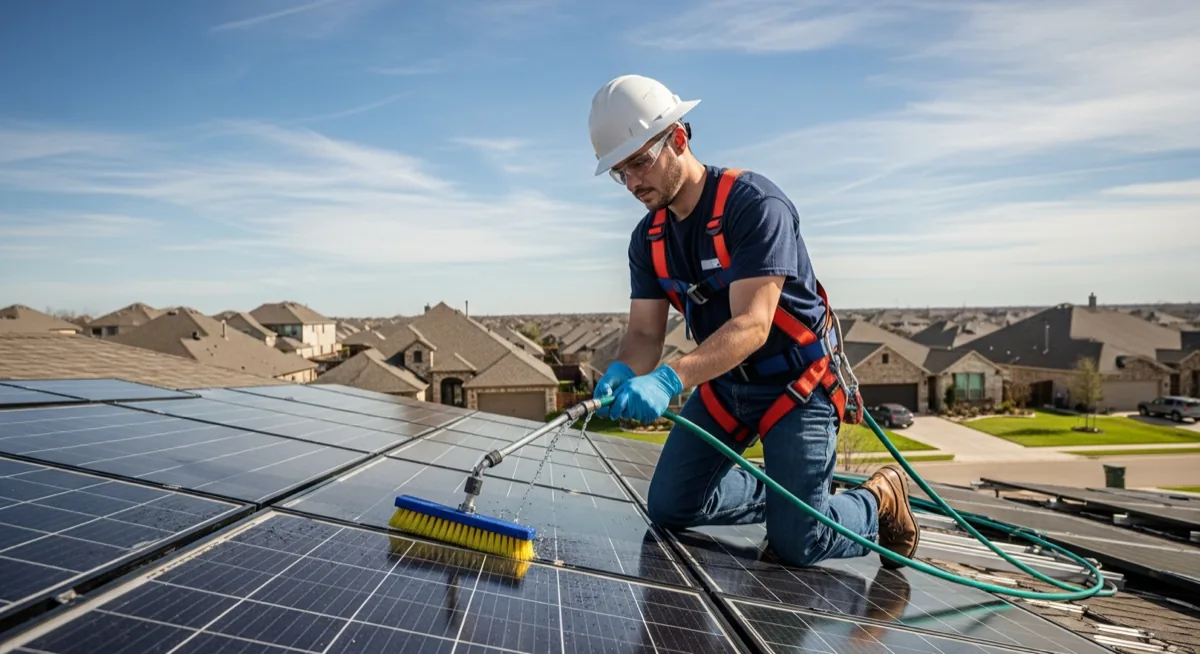
When you do clean, the method matters. Use a garden hose with plain water in the early morning or late evening when panels are cool. Spraying cold water on hot panels can cause thermal shock and micro-cracking. Never use abrasive cleaners, pressure washers, or rough brushes — these scratch the anti-reflective coating and permanently reduce efficiency.
If your panels are on a steep or high roof, hire a professional. The cost is typically $150 to $300 for a residential system, and it is not worth the fall risk. Some installers include one or two cleanings per year in their service agreements — check your contract before paying separately.
Monitoring: Your Most Important Maintenance Tool
The single most valuable maintenance practice is not physical — it is watching your production data. Every modern solar inverter includes a monitoring app or web portal that shows daily, weekly, and monthly production. This data is your early warning system for every kind of problem.
Healthy panels produce consistent output relative to weather conditions. If your seasonal production patterns show a sudden drop that does not correlate with weather changes, something is wrong. Common causes include a tripped breaker, a failed microinverter, a new shade source, or physical damage you have not noticed from ground level.
Check your monitoring weekly. It takes 30 seconds to glance at yesterday's production curve and compare it to the prior week. A single panel with a failed microinverter can reduce your system output by 5% to 8% — on a typical 10 kW system, that is $15 to $25 per month in lost production that shows up as higher grid charges.
Set up alerts. Most monitoring platforms let you configure email or push notifications when daily production drops below a threshold. Set yours to alert when production falls below 70% of expected output for two consecutive days. This catches real problems while ignoring normal cloudy-day variation.
Shade Management: The Slow-Moving Problem
Trees grow. When your solar system was designed, the shade analysis was based on tree heights and canopy coverage at that point in time. Three to five years later, a fast-growing live oak or pecan tree can extend new branches into your panels' solar window, reducing output during peak production hours.
In Dallas and Fort Worth, live oaks and pecans are the most common offenders. In San Antonio, mountain laurels and Texas ash can grow into solar pathways. In Austin, heritage tree ordinances may limit your trimming options, so address shade proactively before branches reach the critical zone.
The impact of partial shading is worse than most homeowners expect. On systems with string inverters, shade on even one panel can drag down the entire string's output. On systems with microinverters or power optimizers, the impact is limited to the shaded panel but still measurable.
Schedule a shade assessment every two to three years, or whenever you notice a production dip during hours that used to be productive. Professional tree trimming for solar access typically costs $200 to $600 depending on the tree size and location.
Inspecting for Physical Damage
Texas weather is hard on everything outdoors, and solar panels are no exception. Hailstorms, high winds, and thermal cycling can cause damage that is not visible from the ground but affects performance.
After any significant hailstorm, visually inspect your panels or have your installer do a post-storm check. Modern panels are rated to withstand 1-inch hail at 50 mph, but Texas regularly produces hail exceeding those specs. Micro-cracks from hail impact may not break the glass but can create hot spots that reduce output and, in rare cases, present fire risks.
Check your inverter and electrical connections annually. Loose wiring, corroded connectors, and degraded conduit are more common in the Texas heat than in milder climates. These issues rarely cause total system failure but can reduce output incrementally — the kind of slow decline that monitoring catches.
Your homeowner's insurance typically covers hail damage to solar panels, but you need to file a claim promptly. Document your system's pre-storm production data from your monitoring app as evidence of any performance degradation.
How Maintenance Connects to Your Electric Bill
Every percentage point of lost production translates directly to higher grid consumption and higher TDU delivery charges. On a system producing 14,000 kWh per year, a 10% production loss means 1,400 kWh of additional grid power — roughly $170 to $210 per year at typical Texas rates.
Over the 25-year life of a solar system, a consistent 10% production shortfall from deferred maintenance costs $4,000 to $5,000 in excess electricity purchases. Compare that to the $300 to $600 per year a reasonable maintenance routine costs, and the math is clear.
If your bills seem higher than your system should produce, start with the diagnostic steps in our high bill troubleshooting guide. Many of the most common causes — monitoring gaps, shade creep, dirty panels — are maintenance issues with straightforward fixes.
Wondering how much you could save with a better plan?
Try our free solar savings calculator — results in 2 minutes.
A Practical Maintenance Schedule for Texas Solar Homeowners
You do not need a complicated maintenance program. This schedule covers what matters:
Monthly: Check your monitoring app for production anomalies. Compare current output to the same month last year.
Twice per year (April and September): Visual inspection from the ground. Look for visible debris, bird nests, or panel discoloration. Clean if needed.
Annually: Check inverter status lights and error codes. Inspect visible wiring and conduit for damage. Review your annual production totals against your system's projected output.
Every two to three years: Professional shade assessment. Professional electrical inspection of connections and grounding.
After severe weather: Visual inspection for cracked glass or displaced panels. Monitor production for the following week for any performance drop.
Consistent, minimal maintenance keeps your system producing at its rated capacity and your electricity bills where you expect them. The goal is not perfection — it is catching problems before they silently cost you hundreds of dollars per year in lost production.
Use our solar savings calculator to see what your system should be producing based on your location, system size, and current electricity plan. If your actual production falls short, maintenance is the first place to investigate.
Want more solar savings tips?
Download our free Texas solar billing guide — learn how to read your bill, find hidden credits, and pick the right plan.
Resources
Helpful guides for solar homeowners
Time-of-Use Rates and Solar in Texas: When They Help and When They Hurt
Learn how time-of-use electricity plans interact with solar panels in Texas, when TOU rates save you money, and how to align generation with consumption.
Read article →
My Solar Bill Is Still High: A Systematic Troubleshooting Guide
A step-by-step guide to diagnosing why your electricity bill is still high after installing solar panels, covering system issues, plan issues, and usage issues.
Read article →
Solar Tax Credits in Texas for 2026: Federal ITC, State Incentives, and How to Claim
Everything Texas homeowners need to know about the federal solar tax credit in 2026, available state incentives, how to file, and common mistakes to avoid.
Read article →